Look it up, then show the page
MIS 752 · Lab 8 Lite · RAG · Book Ch. 20 and 21 · no coding · the handbook and every question here are invented
At the library
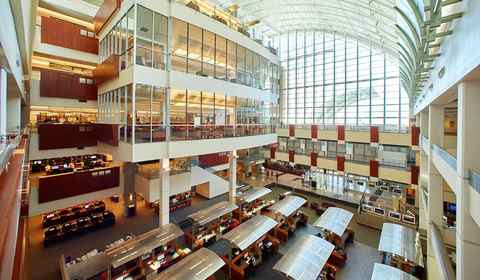 the handbook, copied onto cards
➜
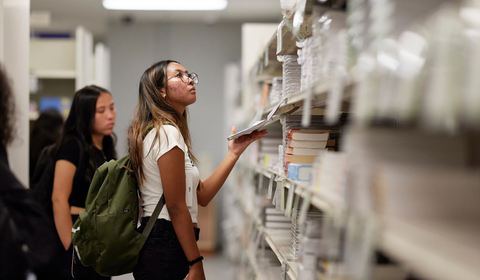 skims, pulls 20
➜
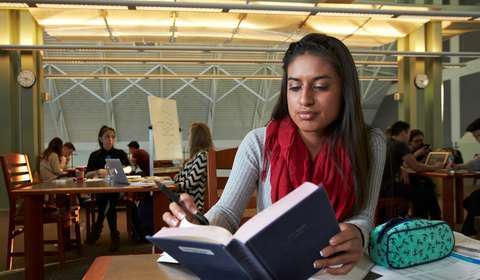 reads those 20, keeps 3
➜
 answers, shows the page
➜
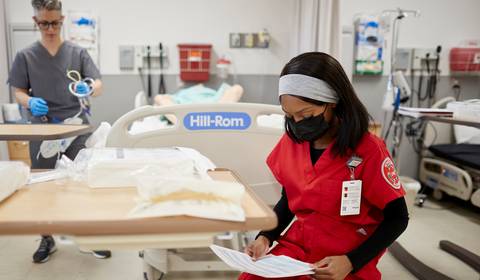 a nurse checks that page
In RAG
📇cards with page numbers
➜
🔎quick skim (vector search)
➜
🧐careful read (reranker)
➜
💬answer + [p. 4]
➜
✅a person can verify it
A good clinician does not answer a dosing question from memory: the habit is to look it up and be able to show where.
RAG (retrieval-augmented generation) makes a model do the same. Find the right cards first, answer only from them, and cite the page.
And when the handbook does not cover the question, a good librarian says so: NOT IN DOCUMENT.
📖 Read Chapter 20, Agentic Workflows II: The Clinical Brain (p. 466) ➜
📖 Chapter 21, Agentic Workflows III: The Patient Navigator (p. 487) ➜
📖 Where RAG is defined: 18.13 Prompting, Retrieval, or Fine-Tuning (p. 431) ➜
Same book on Canvas: course files
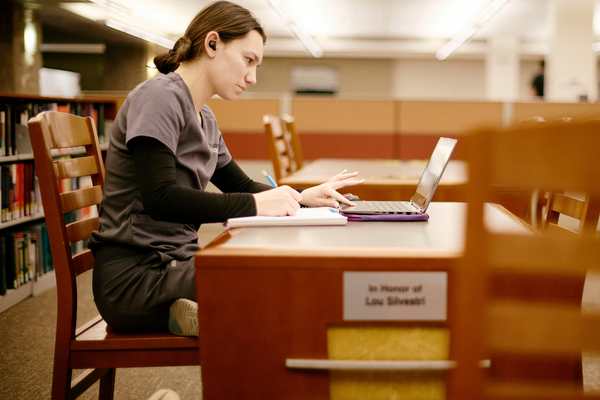
Photos: Josh Hawkins, Becca Schwartz, Aaron Mayes, Benjamin Richards and Anjanette Arnold, UNLV. Real UNLV spaces, starting with Lied Library; the handbook and the questions in this lab are invented.
0 · Connect a model
Paste the free OpenRouter key from Lab 1. It stays in this browser tab only: it is never saved and never sent anywhere except OpenRouter. (Instructor's computer: leave it empty to use the local model.)
1 · The handbook and the librarian
Silver Ridge Health System's clinic handbook: ten pages, invented for this lab. No model has ever seen it, which is the point. It stands in for your own organization's documents.
📘 Silver Ridge Health System
Adult Ambulatory Formulary and Care Protocol Handbook
2026 edition · synthetic teaching document · not clinical guidance
Adult Ambulatory Formulary and Care Protocol Handbook
2026 edition · synthetic teaching document · not clinical guidance
📇 46 cards
The librarian copies the ten pages onto index cards, a few sentences each, with the page number in the corner. No card ever spans two pages, or the citation would be lost. Here are three of them.Two ways to read a card, then two ways to finish
🌐 Try it live: see "nearby meanings" for yourself
Open the Embedding Projector ➜
Free, no account. Built by Google's TensorFlow team.
- It opens with 10,000 English words, each one a dot placed by meaning. Drag to spin the cloud.
- In the Search box on the right, type kidney (or doctor, or drug) and click the word in the list.
- Read its nearest points: the closest words share meaning, not spelling. That closeness is exactly what the quick skim measures between your question and every card.
❓ Find two words that sit close together but would be dangerous to swap in a prescription. What does that tell you about treating "closest" as "correct"?
7 · What the model actually reads
It never sees the whole handbook. It sees three cards and four rules. Finding the right three is the librarian's whole job.
THE ONLY CARDS IT SEES
Run any example above: the three cards the model received appear here, exactly as it saw them.
THE FOUR RULES IT MUST FOLLOW
🧠 Think it through
8 · Design your own handbook
This is the real skill. Think of a moment in your own work when someone needs an answer that only your organization's document has: a policy, a price list, a protocol, a manual. Write a tiny handbook for it, then test it the way this lab tested Silver Ridge's. No code: just plain English.
9 · Your turn
Ask anything about the Silver Ridge handbook: a dose, a target, a screening age, a prior-authorization rule. Or ask something it does not cover, and see which side admits it.
10 · Hand it in (Canvas, Lab 8)
1. Download your submission with the button below, then upload the file to the Lab 8 assignment on Canvas. It holds every question, your predictions, both answers, the cards the librarian kept, your own handbook, and everything you wrote.
2. Answer these five, a few sentences each. Each asks why:
2. Answer these five, a few sentences each. Each asks why:
- When your prediction was wrong, what had you assumed about the model that turned out not to be true?
- An answer with no page scores zero in the Colab lab, even when its facts are right. Do you agree, for a clinic? Would you grade a hotel front-desk assistant the same way? Why or why not?
- Pick the example where the careful read changed the most. In plain words, what did the quick skim get wrong, and why could it not see the difference on its own?
- Your own handbook. Did it answer your first question from the right page and refuse the second? What did you change in your pages, and why did that help?
- A page number makes an answer checkable, not right. Describe one way your handbook could still produce a wrong answer with a correct-looking citation, and who should check it before anyone acts on it.
Nothing you type is stored anywhere. Download your file before you close the tab.
How this page works. The quick skim and the careful read are the same two models your Colab lab uses (all-MiniLM-L6-v2 and the ms-marco-MiniLM-L6-v2 cross-encoder), in compressed 8-bit versions that run inside your browser, so their scores can differ a little from the notebook's. The cards, questions, answer keys, rules and scoring are the notebook's. Only the final answer calls a language model.